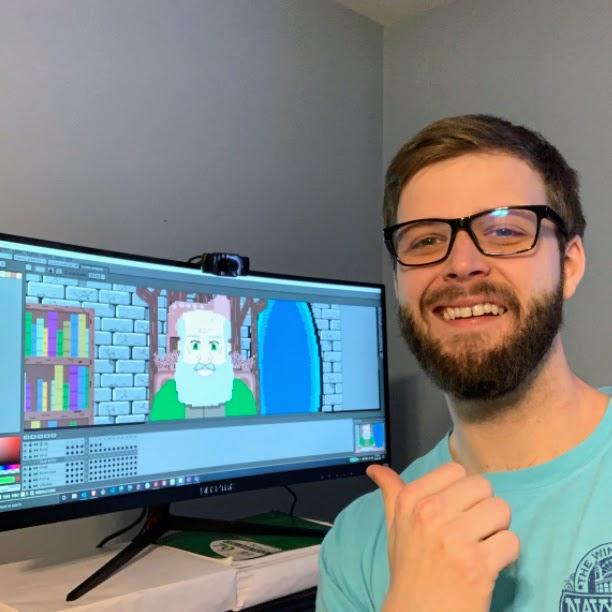
Fulfilling a Five-Year-Old's Promise: The Making of Xal's Path
The story of how a childhood dream to build a video game finally became reality.

Kevin Logan
When I was five years old, video games weren't just a hobby; they were my entire life. I remember sitting in front of The Legend of Zelda: Ocarina of Time, completely immersed, and making a promise to myself: "When I grow up, I'm going to build my own video game."
That promise was the spark that pushed me down the technical path, eventually leading me to become a software engineer.
Fast forward to 2021. I had just finished building my first iOS app and was deep into my work at a startup. I was an experienced developer by then, architecting solutions daily, and I had become proficient in C#.
That's when the realization hit me. I looked at Unity, the number one engine for indie games, and realized its scripting backend was C#, and its IDE felt incredibly similar to Xcode. The technical barrier was gone. I no longer had an excuse. It was time to build the game that 5-year-old Kevin would be excited to play.
The "No Excuses" Scope
I made a rule for myself: Everything had to be built from the ground up. No asset flipping.
- I would write every line of code.
- I would draw the art.
- I would design the narrative.
As a software engineer, I'm used to solving technical problems, so the coding part was actually the easiest leg of the journey. The real grind was everything else.
The Power of Simplicity
One of the biggest traps developers fall into is thinking they need to build the next Elden Ring to make something worthwhile.
My realization came while playing Cookie Clicker. I found myself completely hooked by the simplest mechanic imaginable. That was the lightbulb moment: I don't have to make something complicated for it to be fun.
I decided Xal's Path would be a clicker game. My mission was to prove that you don't need crazy, over-engineered gameplay mechanics to create an experience people enjoy. By keeping the mechanics simple, I could actually finish the project and focus my energy on what really mattered to me: the polish and the story.
The Art of the Grind
I had zero art experience. To fulfill my promise, I took an entire course on pixel art from scratch. I remember taking a full week off from work just to draw the main area where the protagonist, a character locked in a tower, resides. It was humbling to go from being an experienced coder to a total beginner in art, but seeing those pixels come together was worth it.
A Family Soundtrack
For the audio, I called in the cavalry. I collaborated with my brother, who happens to be the Principal Timpanist of the Auckland Philharmonic in New Zealand. We worked together to compose an original soundtrack that captured the mood perfectly (you can actually still find the OST on Spotify and YouTube Music today).
🎵 Listen to the Xal's Path Soundtrack
The Narrative Twist
I didn't want a mindless clicker; I wanted a story with weight, inspired by the moral relativism in The Last of Us.
I wanted the player to feel like the hero, grinding through levels, upgrading stats, and pushing forward. But the narrative goal was to pull the rug out from under you. By the time you reach the end, you hit a realization: You aren't the hero. You are the villain. I love games that teach you something about perspective that you can apply to real life, and that twist was the heartbeat of Xal's Path.
The Bug-Free Launch (and one regret)
My biggest regret wasn't technical; it was administrative. I formed an LLC and filed for a Trademark, which delayed the launch significantly. In retrospect, I should have just shipped it.
However, when I finally did launch, I was thrilled. I ran a rigorous beta test with friends and family, so on launch day, Xal's Path was 100% bug-free. We threw a launch party, downloads started rolling in, and my phone was blowing up with messages. It was a complete triumph.
The Unity Controversy & The Future
So, where is the game now?
In 2023, two things happened. First, an opportunity to start a real estate business took my focus. Second, Unity announced the "Runtime Fee" (charging developers per install). It was a massive controversy in the dev community, and ultimately, I decided to pull Xal's Path from the stores.
But the story isn't over. People still ask me for a sequel or a re-release. I have big plans to bring Xal back, remastered and better than ever. The 5-year-old inside me won't let the project die there.
What 90 Days of Deliberate Inner Work Taught Me
Eight lessons from Jordan Candlish's Embodied Entrepreneur Men's Group on emotional mastery, stillness, and becoming the man you're capable of being.
Xal's Path v1.2.0 - A Sneak Peek at the New Look
A first look at the major update coming to Xal's Path with upgraded art and a modern engine.